











Every engineer has hit this wall. The measurement you need is not a product anyone sells. The off-the-shelf instrument comes close, but not close enough — the trigger condition cannot be expressed, the processing you want is not on the menu, the control loop has to behave in a way no vendor anticipated. So you compromise on the measurement, or you commit to months of FPGA development and the specialist expertise that demands.
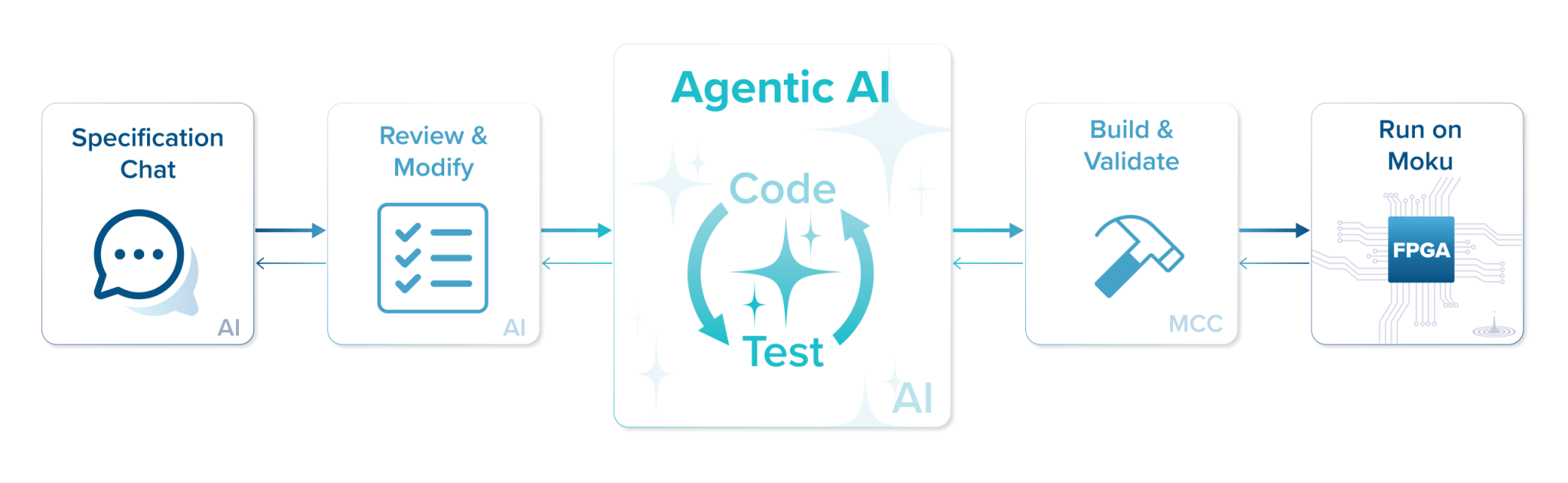
Liquid Instruments has just removed that trade-off. GenInst Studio lets an engineer describe a measurement in plain language and turns it into a working instrument that runs on their Moku.
Not a simulation. Not a script. A real instrument, deployed to the FPGA, running in your test setup.
Why this changes what a Moku is
A Moku was already unusual. Instead of a rack of separate boxes, it is one reconfigurable FPGA platform that becomes whatever instrument you load — oscilloscope, spectrum analyser, lock-in amplifier, phasemeter, PID controller, waveform generator — and lets you run several at once, wiring them together into signal processing pipelines with no cables or adapters.
The catch was always the edge of the catalogue. If the instrument you needed was not in the suite, you were back to writing HDL yourself.
GenInst Studio removes that edge. You describe what you want. It guides you through a specification that captures your design intent, architecture and validation plan, builds the instrument, validates it against automatically generated tests, and iterates until it passes. Then it runs on your Moku alongside the standard instruments.
The effect is that your Moku stops being a device with a fixed list of capabilities and becomes a platform whose limit is what you can describe. The same hardware you bought last year does something new this afternoon.
See how it was built

Two things that make it trustworthy
The workflow is auditable. You can follow how the instrument was specified, tested and validated instead of accepting a black box. When you have to justify a measurement to a colleague, a customer or an auditor, that matters.
The AI is out of the loop once you deploy. The instrument runs on the FPGA with real-time, low-latency, deterministic performance. AI helped you build it. It is not sitting between you and your measurement.
Where it leads
The interesting part is not the instruments GenInst Studio replaces. It is the ones that never got built.
Every lab has a list of measurements that were quietly abandoned because the setup would have taken a quarter to develop, or because the one engineer who could write the FPGA code was busy. Custom triggering that fixed trigger modes cannot express. Hardware-accelerated DSP that has to run in-line rather than in post-processing. Control and sequencing logic shaped around your system’s dynamics. Adaptive stimulus that responds to what the device under test is actually doing.
Those become afternoon experiments. And when the cost of trying an idea drops that far, you try more of them — which is where the real change happens. Not in the instruments you build faster, but in the questions you start asking because asking them is finally cheap.
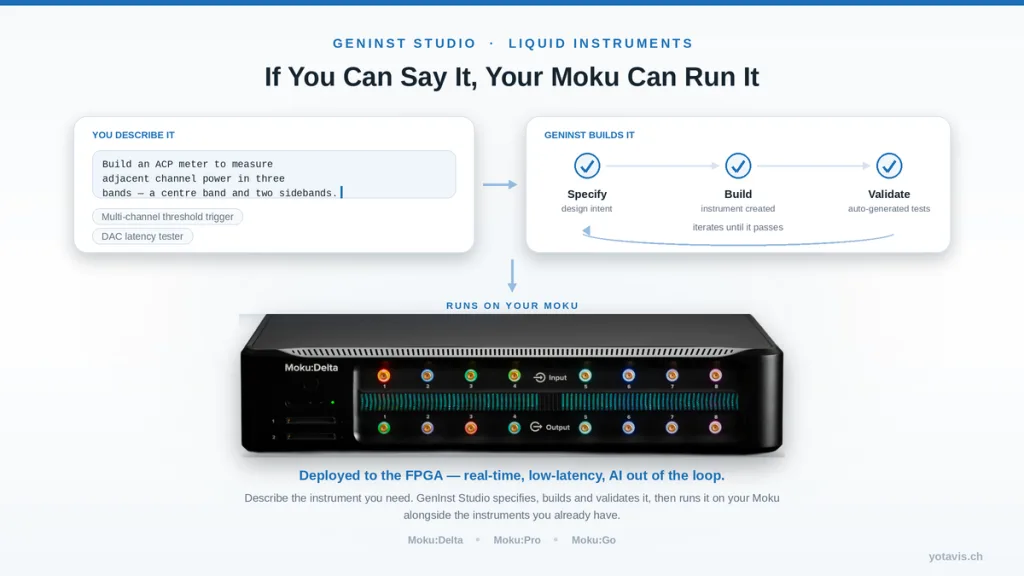
The Moku range at Yotavis
Yotavis is the authorised Liquid Instruments partner in Switzerland, and we supply the full Moku range. GenInst Studio works across the entire family, with the performance scaling to the platform:
- Moku:Delta — the flagship. 2 GHz bandwidth down to true DC, eight analog inputs and eight outputs, 32 digital I/O channels, ultra-low input noise below 10 nV/√Hz on blended 14-bit and 20-bit ADCs, a 1 ppb clock network, and up to eight instruments running simultaneously on a Xilinx UltraScale+ RFSoC FPGA. Built for the most demanding work — quantum, photonics, semiconductor, aerospace and defence.
- Moku:Pro — 600 MHz analog bandwidth, four channels, four simultaneous instruments, a 30 nV/√Hz noise floor at 100 Hz through hybrid front-end ADC blending, and better than 300 ppb clock stability. High-performance R&D in a single box.
- Moku:Go — the portable platform. An engineering lab that fits in a backpack, with optional programmable power supplies, for teaching labs, prototyping and everyday test.
Each platform can be configured as a base bundle and expanded with individual instruments as your work demands, or taken as a full suite from the start. And because Moku is software-defined, the device gets more capable over time — new instruments and features arrive on hardware you already own. GenInst Studio is the clearest example yet of what that means in practice.
Talk to us
If you would like to see generative instrumentation demonstrated on a Moku, work out which platform fits your application, or discuss a configuration for your lab, get in touch with Yotavis. We are happy to advise.