











Characterising a low-power device the traditional way means a bench full of instruments: a power supply, a digital multimeter, an electronic load, an oscilloscope, an arbitrary waveform generator. Each one wired in, each logging separately, none of them quite in sync. Every measurement turns into an exercise in stitching data together and hoping nothing important happened in between.
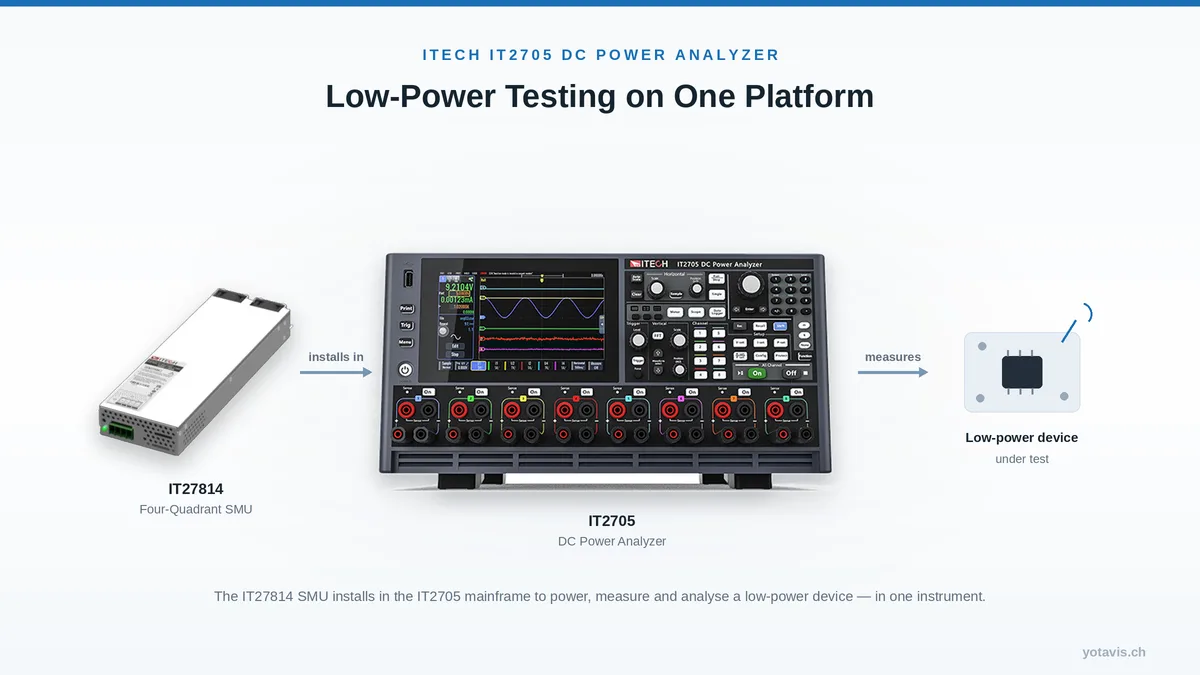
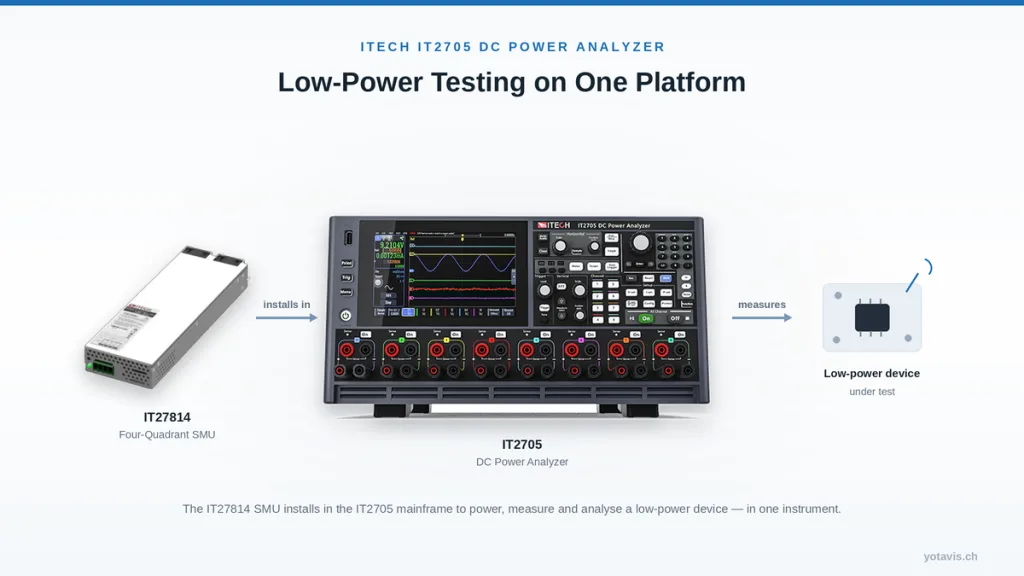
The ITECH IT2705 DC Power Analyzer takes that pile of instruments and folds it into one. Source, load, measurement, oscilloscope and data logging all live in a single modular frame, controlled from one screen. For anyone who tests battery-powered and low-power electronics, that is the difference between a morning of setup and simply running the test.
How it makes the work easier
- One frame instead of five. Source, load, SMU, scope and data logger in the same unit — no cross-wiring, no synchronising separate boxes, no external current probes to fit. What you measure is already time-aligned.
- No gaps at the moment that matters. The IT27814 four-quadrant SMU switches across its four current ranges seamlessly, so the jump from sleep to active is captured without dropping the transition.
- The whole current range in one go. From ±10 µA standby currents up to active peaks in a single capture — no swapping instruments or re-running the test on a different range.
- Realistic battery behaviour on demand. Built-in battery simulation reproduces a real battery across its states of charge, so you can see how the device behaves as the battery ages, without hunting for aged cells.
- Fast transients, caught. Scope sampling up to 200 kHz picks up microsecond-level events — power-on surges, load switches, wake spikes — directly, with no external scope required.
See it in action

A few tests it makes simple
Profiling an IoT sensor from sleep to transmit. Put a Bluetooth or Wi-Fi sensor in standby and measure its sleep current on the fine µA range. When it wakes to transmit, the seamless auto-ranging follows the current straight up into the active peak. One capture gives you the full standby-to-active profile — the basis for a battery-life estimate you can defend.
Checking battery life the way the field will see it. Instead of a bench supply, run the device from the IT27814’s battery simulation and watch how its current draw shifts as the simulated battery discharges. You find out early whether the device still behaves at a low state of charge, rather than after the first field returns come in.
Catching a wearable’s dynamic power. Log current across a real usage sequence — screen on, sensor sampling, radio bursts — and use the built-in scope and data logger to see exactly where the energy goes, so you know which state to optimise first.
Validating a DC-DC or PMIC rail. Use the source and load together in one frame to exercise a converter and capture its transient response and start-up behaviour, without wiring up a separate supply, load and scope.
Where it fits
The IT2705 with the IT27814 SMU is built for low-power design and validation — wherever standby current, dynamic power consumption, peak current and battery life have to be measured:
- IoT devices
- Bluetooth and Wi-Fi modules
- Wearable electronics
- Smart locks
- Wireless sensors
- Low-power MCU applications
Find out more
Yotavis supplies the ITECH range in Switzerland. See the IT2705 and IT27814 product pages for full specifications, or get in touch with Yotavis to match them to your application.