











As renewable generation, energy storage and electric mobility reshape the power grid, the equipment connecting to that grid faces increasingly demanding validation requirements. Inverters, chargers and conversion systems must perform reliably through voltage disturbances, frequency variation and fault conditions long before they reach the field. Meeting those requirements in a controlled, repeatable way is the role of the grid simulator.
Yotavis AG supplies a large range of ITECH grid simulator, the instruments engineers use to reproduce real grid behaviour with laboratory precision. Below is a closer look at how the IT7900 series works, and four real test scenarios where it earns its place in the lab.
The technical foundation
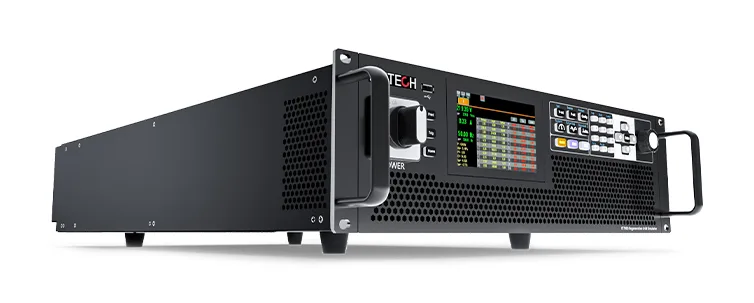
The ITECH IT7900 series is a programmable, four-quadrant grid simulator built on SiC (silicon carbide) power electronics. A few specifications matter more than the rest:
- True four-quadrant operation — 100% current source i sink, so a single unit emulates both supply and load and transitions between them in milliseconds.
- Regenerative by design — energy absorbed from the device under test is returned to the grid at up to 88% recovery, rather than dissipated as heat. On long cycling or endurance tests, that materially reduces both electricity and cooling load.
- Flexible output modes — AC, DC, AC+DC and DC+AC, allowing an AC waveform with a superimposed DC bias, or a DC output with defined ripple.
- Wide frequency range — 16 Hz to 100 Hz, covering 50/60 Hz grids and aviation-frequency work.
- Deep waveform control — harmonic and inter-harmonic synthesis up to the 50th order, 30 built-in distortion profiles, arbitrary waveforms via 1024-point import, and LIST sequencing up to 200 steps.
- Programmable output impedance — so the source behaves like a real (and optionally weak) utility connection rather than an ideal stiff supply.
- Built-in instrumentation — touchscreen, power meter and oscilloscope on board, plus USB/CAN/LAN (LXI) and digital I/O, with GPIB/RS232 optional.
Power density is high (6 kVA in 1U, 15 kVA in 3U), and units combine in master/slave parallel up to 960 kVA, so the same architecture scales from a bench unit to a full system rig.
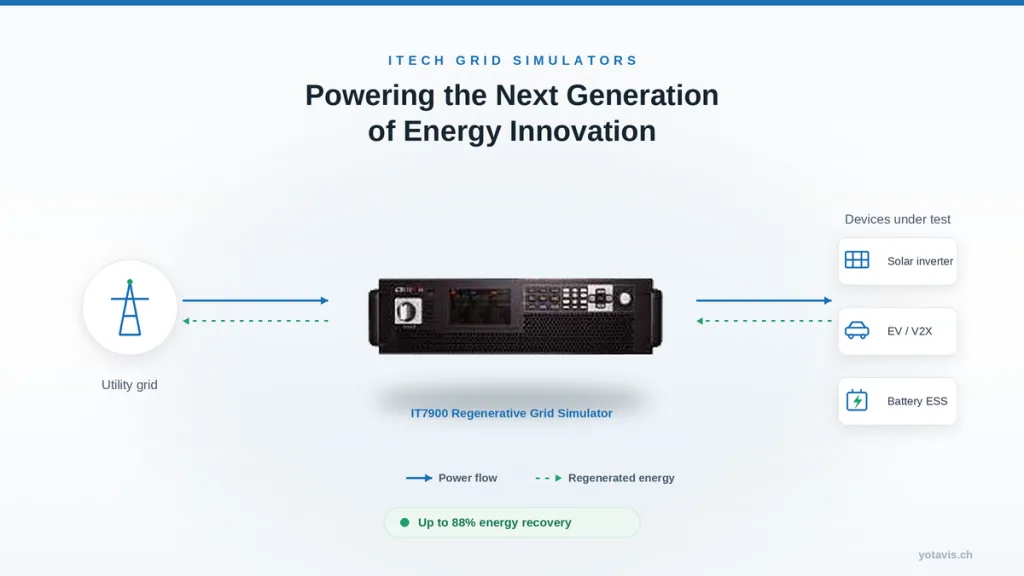
Use case 1: Certifying a PV inverter for grid connection
The challenge. In order to get a photovoltaic inverter connected to the grid, the type of inverter must have demonstrated low-voltage ride-through (LVRT), appropriate reactive-current injection during fault events, and a reliable anti-islanding function.
The method. Set up the voltage dip and voltage rise (LVRT/HVRT) profiles on the simulator and verify that the inverter remains connected and responds as per the grid code, with a specified depth and duration of voltage dip. Next, switch to islanding mode: The one IT7900 constitutes the resonant RLC network required for anti-islanding testing, without the need to connect any external load bank. Last but not least, inject harmonics to check the inverter’s ability to handle a distorted supply.
The value. This instrument includes profiles which are recallable, ensuring repeatability and documentation, with ride-through, anti-islanding and power quality immunity covered.
Use case 2: Validating bidirectional EV chargers and V2X
The challenge. On-board chargers and Vehicle-to-Everything (V2X) systems transfer power in two ways. Testing involves charge and discharge over all four quadrants, and grid synchronisation in the transitions.
The method. The four quadrant architecture provides the power source for charging testing and the power sink for export testing and can switch the power at a rapid rate, which is suitable for real dispatch. The oscilloscope is built in for viewing and analysis of the transient response and Phase-jump and Frequency-variation tests are used to prove that the charger re-synchronises cleanly.
The value. No separate source-load and energy-recovery system to integrate, and the energy recovered can be up to 88%, which means that the running cost of long bidirectional cycling tests is significantly reduced.
Use case 3: Stress-testing a battery storage PCS
The challenge. A battery energy storage system’s power-conversion stage has to operate in grid-following mode and, increasingly, grid-forming mode, then stay stable through grid faults.
The method. Use LIST mode to script a full grid-event sequence, voltage transients, frequency ramps and phase jumps, up to 200 steps, and run it repeatably. Most importantly, do not program the output impedance as an ideal grid, but as a weak grid—that’s what reveals grid-forming stability issues.
The value. By combining realistic weak-grid emulation with scripted, repeatable event sequences, PCS validation can change from the series of one-off manual tests into a controlled and measurable process.
The ITECH IT7900 range at Yotavis
More than 40 models, from a 2 kW benchtop unit to a 900 kW high-voltage system. Match the unit to your power, voltage and tier:
- Compact (2–6 kVA): IT7902-350-10U, IT7904-350-20U, IT7906-350-30.
- E series (21–126 kVA): IT7921E, IT7942E, IT7963E, IT7984E, IT79105E, IT79126E.
- EP high-performance (21–126 kVA): IT7921EP, IT7942EP, IT7963EP, IT7984EP, IT79105EP, IT79126EP.
- High-voltage (700 V): IT79180-700-180 at 180 kVA and IT79900-700-900 at 900 kVA.
All units are regenerative, four quadrant and remote controlled for automated test environments with the same waveforms and compliance feature set throughout the range.
Talk to Yotavis
If you are specifying a grid simulator for PV, energy storage or e-mobility testing, our team can help you size the right model and configuration. Browse the full ITECH grid simulator range lub request a quote.